


Human Rights:
Towards a Global Values System
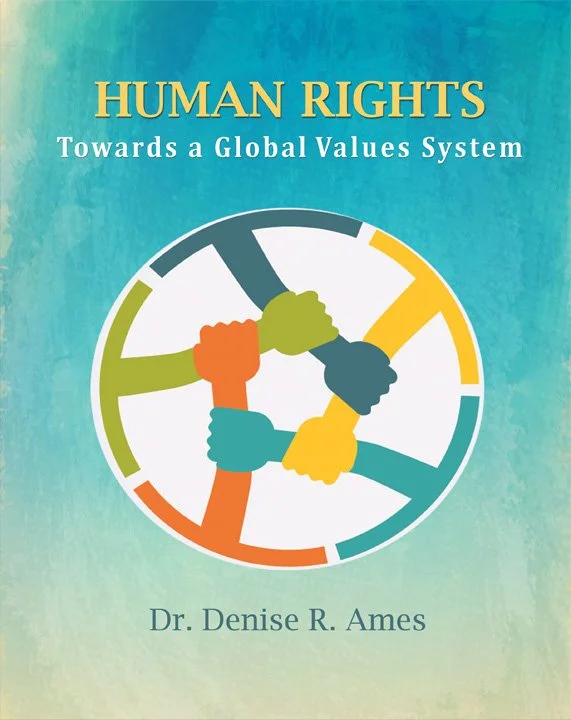
This book examines human rights from both global and historical perspectives. While numerous obstacles stand in the way of realizing universal human rights, the dedicated efforts of social movements, activists, and organizations around the world demonstrate that meaningful progress is possible. Includes illustrations, an index, glossary, source notes, and bibliography. 215 pgs., $17.95
This book is for adult learns, educators, and students (9-university. Each chapter includes “Questions to Consider,” spurring critical thinking and “seeing” the information differently.
This book examines human rights from both global and historical perspectives. Educator Dr. Denise R. Ames argues that human rights provide the foundation for a democratic global values system and that individuals and organizations around the world are working to make this vision a reality. Although significant obstacles continue to impede the universal realization of human rights, the dedicated efforts of social movements, activists, and committed organizations demonstrate that meaningful progress is possible.
As respect for human rights becomes more deeply embedded in societies around the world, these principles become more difficult to undermine and increasingly serve as the foundation of a shared global values system. This book is dedicated to advancing that vision.
We hope this book encourages you to think about human rights in new ways, deepens your understanding of the historical and global forces that have shaped them, and inspires you to become actively engaged in promoting and protecting human rights in your own community and beyond.
Human Rights: Chapter Summaries
-
1. Human Rights: An Introduction
To provide a strong foundation for understanding the subject, this chapter introduces the definitions, characteristics, and categories of human rights. It also explores the historical and philosophical development of human rights by examining how the Ethic of Reciprocity—commonly known as the Golden Rule—has been expressed across diverse cultures, religions, and philosophical traditions throughout the world.
Students in China, photo Denise Ames
-
2. Social Movements and Human Rights
This chapter defines social movements and examines their types, strategies, and life cycles. It traces social movements across three historical periods: the Early Era (1800–1945), the Modern Era (1945–1990), and the Global Era (1990–present). The chapter explores various movements: civil rights, environmentalism, women's suffrage, education, global justice, Indigenous and LGBT rights, and others.
Children in Finland, photo Denise Ames
-
3. Human Rights Violations
This chapter examines four of the gravest violations of human rights: the crime of aggression, war crimes, crimes against humanity, and genocide. Particular attention is given to genocide through five historical case studies, including in-depth examinations of two of the twentieth century's most devastating genocides—the Holocaust and the Rwandan Genocide.
Women Weaving in Bahrain, photo Denise Ames
-
4. Case Studies of Human Rights Abuses
Selected case studies of human rights abuses examined in this chapter include the Zulu in South Africa, the Democratic Republic of the Congo, Armenia, Ukraine, Cambodia, Guatemala, Bosnia and Kosovo, the Taliban, and the crisis in Darfur.
Mayan ruins in Belize,photo Denise Ames
-
5. Human Rights Activists
This inspiring chapter highlights the compassionate and courageous side of humanity. It shares the stories of six activists who dedicated their lives to advancing human rights, social justice, and human dignity: Wangari Maathai (Kenya), Shirin Ebadi (Iran), Aung San Suu Kyi (Burma/Myanmar), Rigoberta Menchú (Guatemala), Muhammad Yunus (Bangladesh), and His Holiness the Dalai Lama (Tibet).
Check point, Berlin, Germany, photo Denise Ames
-
6. Human Rights Today
This positive and forward-looking chapter examines how human rights campaigns are being carried out today. It explores the roles of the United Nations, international organizations such as Amnesty International, Human Rights Watch, and the Carter Center, as well as local organizations such as the Albuquerque Center for Peace & Justice in the author’s hometown of Albuquerque, NM, USA. The chapter concludes by exploring the future of human rights and the possibilities for advancing it.
Iran, photo Denise Ames
