


The Global Economy:
Connecting the Roots of a Holistic System
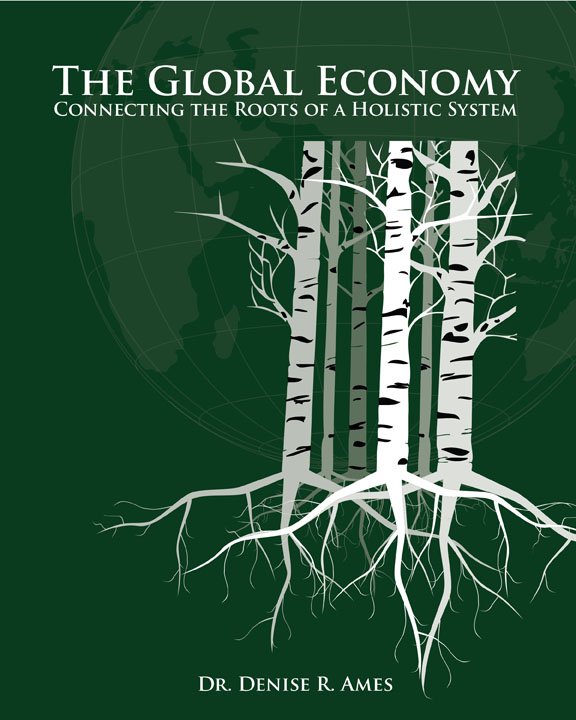
The Global Economy helps make sense of the complex and often overwhelming economic forces that directly affect you, your future, and the lives of people around the world.
Using a holistic and accessible approach, this book provides a realistic understanding of the global economy and its interconnected relationship with society and the environment. It examines neoliberalism, financialization, and economic globalization, revealing how these powerful forces shape the experiences, opportunities, and challenges of everyday people.
$19.95, 358 pgs. Illustrated, index, glossary, source notes, bibliography, and graphic organizers.
This book is designed for adult learners, educators, and students from grades 9 through university. Each chapter includes “Questions to Consider” that encourage critical thinking, reflection, and new ways of seeing and understanding the information presented.
The Global Economy ....
Are you confused by the forces shaping the global economy? Why is the middle class in the United States shrinking? Why have the top 1% and 20% experienced such significant gains while many in the bottom 80% face stagnant wages and growing economic challenges?
The Global Economy helps untangle the complex and often overwhelming economic forces that directly affect your life, your future, and the communities around you. By developing a clearer understanding of how the global economy operates, we become better equipped to analyze its strengths and weaknesses, recognize its fault lines, and imagine more effective solutions.
The Global Economy was a hit in Dr. Julia Reyes’ class at Metro State University in Denver, CO.
A few student comments …
It is a very powerful read, overall, an absolutely fantastic read.
It was organized, well written and constantly assured the person unaware of the complexity of our world economics they were not the only people confused. I personally needed that reassurance.
This book could be used to teach basic world economics, or just essential information for all people trying to understand our complex world economic situation.
Table of Contents
Chapter 1. An Overview of the Global Economy
Chapter 2. Historical Roots of the Global Economy
Chapter 3. The Neoliberal Stew: A Dozen Essential Ingredients
Chapter 4. The Impact of Neoliberalism in the United States: Ten Consequences
Chapter 5. The Economic Globalization Puzzle: Ten Pieces
Chapter 6. The Impact of Economic Globalization
Chapter 7. The Financial Sector: Ten Fatal Flaws
Chapter 8. The Financial Sector: Crisis and its Aftermath
Author’s note about The Global Economy: Connecting the Roots of a Holistic System
I have always been fascinated by how and why the economy works as it does. When I began researching and teaching world history in the early 1990s, I discovered that economic systems, like other cultural patterns, evolve and change over time. My encounters with the former Soviet Union in 1989 and with the simple Amish communities of central Illinois further sparked my curiosity about how alternative economic systems functioned in comparison to our capitalist model.
With the formation of our nonprofit organization, the Center for Global Awareness, I was finally able to bring together my research, observations, and reflections into a book on the global economy. Because I am a historian rather than an economist, I wanted to examine the global economy from an outside perspective—to explore how the system actually functions rather than simply present the idealized version often described in economic textbooks.
My purpose in writing this book is to offer a thoughtful critique of the capitalist system as it operates today. I believe the current system is not serving the majority of the world’s population well and is placing increasing pressures on the environment. However, my goal is not to be confrontational, but rather to encourage a broader conversation and provide another perspective. Ultimately, I hope readers will draw their own conclusions about whether the global economy is working effectively for themselves, their families, their communities, their nations, and the global community as a whole.
Few books provide a general overview and realistic portrayal of the global economy from a holistic perspective. After introducing key terms and concepts and exploring the historical roots of our economic system, this book examines three major dimensions of the contemporary global economy: neoliberalism (free-market capitalism), economic globalization, and financialization. The final chapter offers recommendations and possibilities for creating a more equitable and sustainable economic future.
Having witnessed many of these economic changes firsthand, I include some of my own experiences and reflections to provide a personal perspective on the transformations that have shaped our world. I encourage you to do the same. Talk with family, friends, and others in your community about what they have experienced. You will likely discover a wide range of perspectives and fascinating insights. Everyone has a story to tell.