


The Center for Global Awareness Approach
“Global Awareness is recognizing the interconnectedness of our lives with people and living beings across the world.” … Dr. Denise R. Ames
The Center for Global Awareness (CGA) offers a unique global-awareness approach woven into its programs, publications, travels, and educational materials—an approach flexible enough to be applied across a wide range of initiatives.
CGA fosters global awareness through a diverse range of educational and travel programs that enable participants to explore world history, engage with different cultures, examine global issues, appreciate diverse perspectives, and cultivate both personal and global well-being.
What does global awareness mean?
CGA defines global awareness as recognizing the interconnectedness of our lives with people and living beings across the world. It is a way of understanding the world—an outlook or philosophy—that broadens our mindset by integrating local, national, or conventional perspectives with an understanding of how people, cultures, economies, environments, and events are linked globally. In short, global awareness weaves together the local and the global.
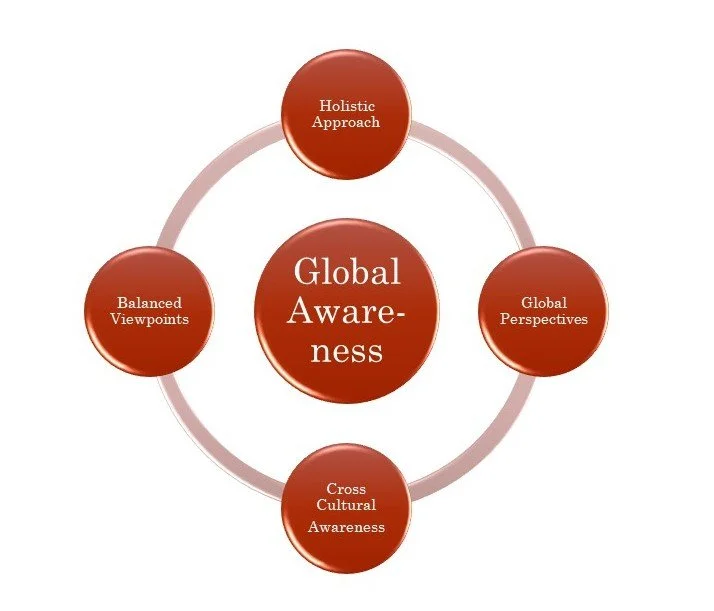
CGA has identified four key facets of global awareness: a holistic approach, global perspectives, cross-cultural awareness, and balanced viewpoints.
1. A Holistic Approach: Seeing the Big Picture
Holistic looks at the whole not just individual parts.
Holistic means looking at something as a whole rather than focusing only on individual parts. A holistic approach considers how different elements are connected and how they influence one another. Instead of examining things in isolation, it seeks to understand the bigger picture—the relationships, patterns, and broader context that shape what we see.
“Holistic” refers to the full range of relationships among a system’s cultural traits and how the functioning of each part helps sustain the whole. In the context of history and the social sciences, a holistic approach examines how a society’s cultural traits interact with, reinforce, and support one another. These traits include politics, economics, technology, culture, religion, values, and the treatment of the environment. A change in any one trait creates a ripple effect that influences all the others.
A Holistic Approach, For Example:
When addressing an issue such as climate change, it is essential to view it not in isolation but within the context of a complex system that includes the economy, political structures, prevailing worldviews, technological developments, religious influences, and other interrelated factors.

A holistic approach:
Looks at the whole system not just the parts
Sees the relationship of the parts to the whole
Considers the long-term consequences of actions and events
Advocates for a big-picture context
Recognizes the interaction of cultural traits
2. A Global Perspective: Broadening our Views
A global perspective is a way of seeing the world that broadens our viewpoints and intellectual skills beyond our own world, to include a more global outlook.
A conventional viewpoint tends to treat one’s own country, culture, personal experience, and way of life as the universal standard, whereas a global perspective encourages a more expansive understanding of the world.
A global perspective involves looking beyond simplistic explanations of complex issues and recognizing global phenomena as part of a constellation of interrelated factors. Ideally, it enables individuals to form opinions about the world through broad, flexible inquiry rather than through rigid, unexamined, or questionable assumptions.
In short, a global perspective helps us understand the world as an interconnected whole and encourages us to think beyond the boundaries of our own experiences. Although CGA advocates using a global perspective, it also recognizes the importance of integrating traditional viewpoints into our ways of knowing. A wise person can hold two or more seemingly opposing ideas at the same time.
A Global Perspective, For example:
An American using a global perspective recognizes and appreciates that individualism is a key value in the United States, but also understands that it may not hold the same importance in other countries.

Zoroastrian symbol of world peace, Iran, photo Denise Ames
A global perspective …
· Recognizes diverse viewpoints
· Realizes global interdependence
· Broadens our perspectives
· Integrates conventional and
global views into ways of knowing.
· Sees issues in a global context
3. Cross-Cultural Awareness: Recognizing What’s Outside our Bubble
Cross-cultural awareness is the ability to recognize, understand, and appreciate the differences and similarities among people from diverse cultural backgrounds.
It involves being mindful of how cultural norms, values, beliefs, behaviors, and communication styles shape interactions in both personal and professional settings.
Today, many social and political divides have become rigid and deeply entrenched, often blinding us to meaningful cross-cultural differences. We retreat into bubbles of comfort and isolation. At CGA, our mission is to break through these barriers by fostering a deeper understanding of cultural diversity—both within our own country and around the world. Recognizing and respecting these differences is not only valuable; it is essential.
Cross-Cultural Awareness, For Example:
In some cultures, direct eye contact is a sign of confidence, while in others it may be considered rude. Cross-cultural awareness helps you navigate such differences successfully.

A cross-cultural outlook:
· Acknowledges the limitations of
one’s individual perspective
· Is self-aware
· Practices flexibility and open-
mindedness
· Understands cultural differences
· Walks in another person’s shoes
4. Balanced Views: Considering Multiple Sides
Balance means having the right amount—not too much or too little—resulting in harmony and steadiness.
Balanced viewpoints are perspectives that fairly consider multiple sides of an issue rather than being one-sided or biased. They demonstrate careful thought, openness, and a willingness to weigh evidence, arguments, and diverse perspectives before reaching a conclusion.
Using this sense of balance means avoiding single-cause explanations for complex problems, as most issues require weighing multiple factors to arrive at meaningful, lasting solutions. Considering different perspectives typically leads to greater awareness. We should be wary of overly simplistic answers to complicated problems, as they are often naïve or misguided. In many cases, there may be no perfect solution—only the option that is least problematic.
Balanced Views, For Example:
When discussing a controversial policy, a person with a balanced viewpoint would consider the benefits, the drawbacks, and the perspectives of different stakeholders before expressing their opinion.
Balanced Viewpoints:
Consider multiple perspectives
Embrace fairness
Favor critical thinking
Avoid extremes
Realize there are no perfect answers
Embracing Global Awareness Means ….
-
Thinking Holistically
Refers to the full range of relationships among a system’s cultural traits and how the functioning of each part helps sustain the whole.
-
Understanding Relationships
A society’s cultural traits--politics, economics, technology, culture, religion, values, and the environment-- interact with, reinforce, and support one another.
-
Envisioning a Big Picture
Events, actions, people, history, culture, and issues are placed into an overarching broader context for a clearer look at all the variables.
-
Being Self-Aware
Recognizing our own cultural biases, assumptions, and perspectives, while understanding that others may differ from our our opinions and experiences.
-
Practicing Critical Thinking
Evaluating information, evidence, and arguments objectively before reaching a conclusion. Using comparative thinking to see differences and similarities.
-
Balancing Viewpoints
Avoiding extremes and recognizing complexity and nuance rather than oversimplifying an issue. Being fair and nonjudgmental.
-
Walking in Another's Shoes
Trying to see the world as another person would see it, rather than judging based only on your own experiences, avoiding judgment or stereotyping.
-
Opening the Mind
Being willing to revise your opinion in light of new evidence or strong arguments. Being flexible, adaptable, and curious to new things.